Dallas, TX · 24/7 Emergency Service
Emergency Water Extraction in Dallas, TX
Industrial-grade pumps and extractors deployed within the hour. Standing water removed from any structure — residential or commercial — across Dallas and the DFW Metroplex.
Call (469) 771-0564 — 24/7 EmergencyWhy Speed Is Everything
Every Minute of Standing Water Multiplies Damage
When water enters your Dallas home or business, a clock starts ticking. Within the first hour, water saturates drywall, seeps under flooring, and penetrates wall cavities. Within 24 hours, structural wood begins to swell and warp. Within 48–72 hours — especially in Dallas's heat — mold can begin colonizing wet materials. The single most important action you can take after a flood is getting standing water out as fast as possible.
Dallas Flood Pros operates with a one-hour dispatch target across the Dallas metro. Our trucks are equipped with truck-mounted extraction units capable of removing hundreds of gallons per minute, supplemented by portable submersible pumps for areas trucks can't directly access. We don't send a single technician with a shop vac — we send a team with professional-grade equipment matched to the severity of the loss.
DFW's flood landscape demands this level of readiness. The Trinity River basin, which bisects the city, creates flood plain exposures from Irving through downtown Dallas and into the Elm Fork corridor near Carrollton. Duck Creek in Garland and Rowlett Creek corridors can flash-flood during severe thunderstorm events in 20–30 minutes. Mesquite Creek backs up in heavy rain. In each of these scenarios, homeowners may face water entering from multiple directions simultaneously — storm drain backup, ground saturation, and surface flooding all at once. Our extraction crews are trained to address multi-source intrusion, not just the obvious pooled water.
Water Extraction — By the Numbers
| Specification | Detail |
|---|---|
| Dispatch Target | Within 1 hour of call receipt, 24/7 |
| Extraction Equipment | Truck-mounted units + portable submersible pumps + wet/dry HEPA vacuums |
| Capacity | Commercial truck mounts extract up to several hundred GPM; scaled to loss size |
| Water Categories Handled | Category 1 (clean), Category 2 (grey water), Category 3 (black water / sewage) |
| Drying Phases After Extraction | Phase 1: Bulk extraction → Phase 2: Structural drying setup → Phase 3: Daily monitoring |
| Moisture Documentation | Pre- and post-extraction moisture readings logged for insurance |
| Certification Standard | IICRC S500 Standard for Professional Water Damage Restoration |
| Insurance Billing | Direct billing to all major carriers; adjuster coordination available |
Our Process
From First Call to Dry Structure — 6 Steps
Emergency Arrival & Assessment
Our crew arrives within the target one-hour window. The lead technician performs an immediate walk-through to identify water sources, assess category (clean, grey, or black water), and document initial moisture readings using calibrated meters and thermal imaging cameras. This assessment drives the entire extraction and drying plan.
Bulk Water Extraction
Truck-mounted extractors and submersible pumps remove standing water as rapidly as possible. For flooded basements, lower levels, or large commercial areas, we may deploy multiple extraction units simultaneously. Water is removed to the degree possible before structural drying can begin — surface water, water pooled in carpet and pad, and water in low points throughout the structure.
Selective Demolition
Saturated drywall, insulation, and flooring materials that cannot be dried in place are removed. This is a critical step that many homeowners resist, but wet materials hidden inside walls or under floors become mold incubators. We document everything removed with photos and lists for your insurance claim, and we save what can genuinely be saved.
Structural Drying Setup
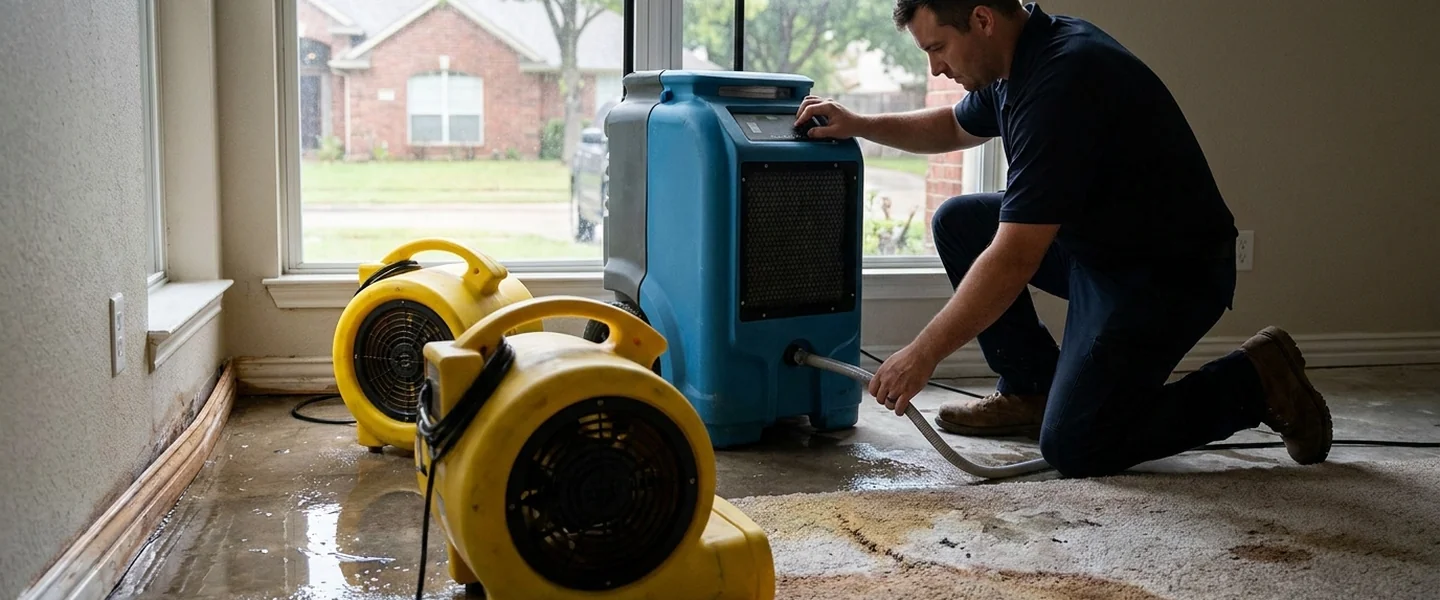
Commercial LGR dehumidifiers and high-velocity air movers are positioned according to a psychrometric drying plan — the right equipment at the right locations to create airflow through wall cavities, under subfloors, and across all wet surfaces. Desiccant systems may be added for deeply saturated structural components or unusual configurations.
Daily Monitoring & Moisture Testing
We return daily to check moisture readings at logged test points. Drying equipment is adjusted based on readings — moved, added, or removed as sections reach drying goals. Every visit is documented with moisture data and equipment notes. This drying log becomes part of your insurance claim package.
Final Clearance & Restoration Planning
When all moisture readings confirm structural dryness per IICRC S500 standards, we conduct a final walkthrough with documentation. If mold remediation was performed, air quality testing confirms clearance before we close. We provide a complete project summary for your insurance carrier and discuss reconstruction options.
Dallas-Specific Flood Risks
Understanding DFW's Water Damage Landscape
Trinity River Basin Flooding
The Trinity River and its tributaries cut through Dallas County, creating significant flood plain areas. Irving's western edge, south Dallas, and low-lying areas near the river can flood rapidly when upstream rainfall overwhelms the levee and detention system capacity. Trinity River flood events often affect commercial properties and entire neighborhoods simultaneously.
Creek Corridor Flash Flooding
Duck Creek (Garland), Rowlett Creek, White Rock Creek, Mesquite Creek, and Elm Fork corridors can flash-flood within 20–30 minutes of heavy rainfall. Homes in these creek corridors may have only minutes of warning before water enters. Our emergency dispatch is built for this scenario — fast response is the only answer.
Frozen Pipe Bursts
The February 2021 winter storm Uri proved that DFW homes are not adequately insulated against extreme cold events. Dallas homes routinely have pipes in exterior walls and attic spaces without adequate freeze protection. When arctic blasts hit, pipe bursts can release hundreds of gallons before the homeowner even realizes what happened.
Storm Drain Backup
Rapid development across DFW has created enormous impervious surface coverage. During intense summer thunderstorms — which can drop 3+ inches per hour — municipal storm drains back up into homes through floor drains, window wells, and basement entries. Lower-level finished spaces are especially vulnerable.
Common Questions
Water Extraction FAQs
How fast can you arrive after I call?
Our target is one hour or less for all of Dallas and the immediate DFW metro area. Dispatch is 24/7, including weekends and holidays. When you call, we immediately dispatch the nearest available crew — we don't put you on hold or schedule you for the next morning.
What if water is still coming in when you arrive?
We cannot stop the source — that requires a plumber (for pipe breaks) or the storm to pass (for flooding). However, we work alongside your plumber and begin extraction the moment water flow is controlled. In some flood events, we extract while conditions stabilize, buying time to reduce damage. We can also advise on emergency shutoffs for your water main if a pipe break is the source.
Can you extract water from carpet? Will carpet be saved?
We extract water from carpet and carpet pad. Whether carpet can be saved depends on the water category (clean vs. grey vs. black water), how long it was wet, and its condition. Category 1 water-soaked carpet extracted within hours can sometimes be dried in place. Category 2 or 3 saturated carpet typically must be removed per IICRC standards for health and structural drying reasons. We assess each situation honestly and document the decision for your claim.
Do you handle sewage backup cleanup as well?
Yes. Sewage backup is Category 3 (black water) — a biohazard requiring specialized handling. Our technicians are trained and equipped for black water extraction and decontamination. All contaminated materials are removed and disposed of properly. Learn more on our Sewage Cleanup page.
How long does water extraction take?
Bulk extraction — removing standing water — typically takes 1–4 hours depending on the volume and affected area. After extraction, structural drying equipment runs for several days (typically 3–5 days minimum, sometimes longer for heavy losses) until moisture readings confirm the structure has reached drying goals. Extraction and drying are two distinct phases.
Is it safe to stay in my home during extraction and drying?
It depends on the scope and water category. Category 1 water losses in limited areas may allow occupancy while drying equipment runs. Category 2 or 3 losses, or events affecting HVAC systems or large structural areas, may make occupancy impractical or inadvisable. We'll give you an honest assessment of your specific situation. The drying equipment is noisy and generates heat, which most people find uncomfortable for extended occupancy.
Will my insurance cover emergency water extraction?
Most standard homeowners policies cover sudden and accidental water damage, which includes burst pipes and certain types of storm-related water intrusion. Flood damage from rising water (storm flooding) is typically covered only by separate flood insurance through FEMA's NFIP or private carriers. We provide all the documentation your adjuster needs and handle direct billing — but we recommend calling your insurance carrier promptly after you call us.
What equipment do you use for extraction?
Our primary extraction is performed with truck-mounted extraction units — powerful industrial systems that far exceed any portable or rental unit. We supplement with submersible pumps for deep standing water (basements, crawlspaces), and HEPA-filtered portable extractors for areas the truck mount cannot directly access. For very large commercial losses, we may deploy multiple truck units simultaneously.
Standing Water Right Now? Call Immediately.
Every hour of delay extends the drying timeline and increases total damage. Dallas Flood Pros dispatches certified water extraction crews 24/7 — call now and get help on the way.
Call (469) 771-0564 — 24/7 Emergency