Dallas, TX · IICRC S500 Certified Drying
Structural Drying Services in Dallas, TX — 24/7 Emergency Response
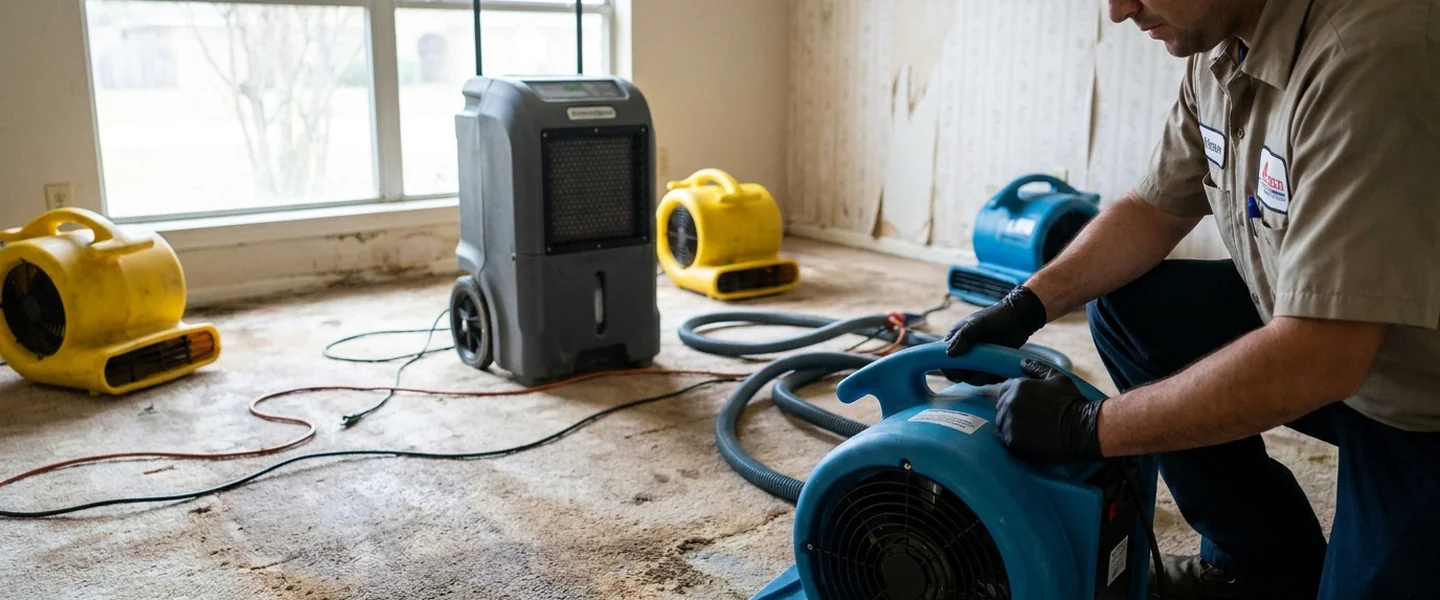
Commercial-grade dehumidifiers, high-velocity air movers, and real-time moisture mapping. We dry your structure to IICRC standards and provide complete drying logs for your insurance claim.
Call (469) 771-0564 — 24/7 EmergencyBeyond the Visible Water
Structural Drying: The Science Behind Flood Recovery
Most people focus on the visible flooding — the standing water that extraction removes. But structural water damage goes far deeper. Water wicks into drywall, travels along wall studs, saturates insulation, penetrates subfloor sheeting, and soaks into concrete slab materials. When a Dallas home floods, the structure itself absorbs enormous amounts of moisture that a mop, fans, and open windows simply cannot address.
Structural drying is the science of removing that embedded moisture systematically and verifiably. It requires understanding psychrometrics — how temperature, relative humidity, and air movement interact — and deploying the right combination of dehumidification and airflow to draw moisture out of materials and into the air where dehumidifiers can capture it. Done incorrectly, "dried" walls can still harbor 20–30% moisture content: enough to fuel mold growth within weeks.
Dallas's climate presents unique structural drying challenges. The outdoor humidity and temperature conditions dramatically affect how drying equipment must be sized and configured. In August, Dallas outdoor air can be 95°F with 50% relative humidity — conditions that actually impede drying if outdoor air is introduced without proper dehumidification. In winter, cold and dry outdoor conditions can be leveraged differently. Our technicians understand Dallas's seasonal climate and configure drying systems accordingly — this is not a one-size-fits-all process.
The IICRC S500 Standard for Professional Water Damage Restoration defines the protocols we follow. This includes establishing drying goals (target moisture content for each material type), creating a psychrometric drying plan, monitoring daily with calibrated instruments, and maintaining a documented drying log from start to finish. That drying log is a critical insurance document — it proves that the structure was properly dried and helps justify the scope of remediation work for your adjuster.
Professional Equipment
The Right Tools for Dallas's Climate
LGR Commercial Dehumidifiers
Low-Grain Refrigerant (LGR) dehumidifiers are the workhorses of professional structural drying. Unlike consumer units, commercial LGR dehumidifiers operate at grain depression rates far below what standard dehumidifiers can achieve, making them far more effective at removing deeply embedded structural moisture. We size dehumidification to the cubic footage and material loading of your specific loss.
High-Velocity Air Movers
Industrial air movers are placed at calculated angles and distances to create vortex airflow patterns across wet surfaces. The movement accelerates evaporation from materials and carries moisture-laden air toward dehumidifier intakes. The positioning of air movers — not just their quantity — determines drying effectiveness. Our technicians follow placement protocols developed through IICRC training.
Desiccant Dehumidifiers
For deeply embedded structural moisture, unusual configurations, or cases where refrigerant-based dehumidification reaches its limits, desiccant dehumidifiers provide supplemental moisture removal. These systems work through chemical absorption rather than refrigeration and can operate effectively at lower temperatures — useful for garage spaces, attics, or winter events.
Thermal Imaging Cameras
Infrared thermal imaging reveals moisture migration patterns invisible to the naked eye. Cold spots in walls indicate evaporative cooling from embedded moisture — moisture that would otherwise go undetected until mold appears weeks later. Thermal imaging drives our demolition decisions and drying equipment placement, and images are included in the insurance documentation package.
Calibrated Moisture Meters
We use both pin-type and pinless moisture meters at documented test points throughout the affected area. Pin meters provide precise readings in wood and drywall; pinless meters scan through materials non-destructively. Readings are logged at every monitoring visit, creating the chain of evidence that proves the structure reached appropriate drying goals.
Psychrometric Data Loggers
Temperature and relative humidity data loggers placed throughout the drying chamber track conditions continuously. These records allow us to verify that drying conditions were maintained between visits and adjust equipment as needed. The data logs are exported and included in the complete insurance documentation package.
How It Works
The Structural Drying Process, Step by Step
Moisture Mapping & Documentation
Before placing a single piece of equipment, we map the moisture content of every affected material and surface — walls, floors, ceilings, cabinets. This baseline moisture map defines the scope of the drying project and becomes the first entry in the drying log that accompanies your insurance claim.
Psychrometric Calculations & Equipment Sizing
Using psychrometric calculations based on the affected volume, material types, and current conditions, we determine the number and type of dehumidifiers and air movers required. Under-equipping a drying project prolongs the timeline and increases total damage; our calculations ensure adequate equipment from day one.
Selective Demo for Drying Access
Materials that trap moisture and cannot be dried in place — saturated insulation, drywall below the flood line, certain flooring types — are removed to allow airflow to reach structural cavities. This is called "flood cuts" in the industry. Every material removed is documented and photographed for your claim.
Equipment Placement & Containment
Dehumidifiers and air movers are placed per the drying plan. If necessary, plastic containment is set up to isolate the drying zone and maximize efficiency. This is particularly important in open-plan homes or when only part of a structure is affected — containment concentrates the drying power where it's needed.
Daily Monitoring & Adjustment
A technician visits daily to record moisture readings at all documented test points, note temperature and humidity conditions, and adjust equipment as needed. Equipment may be repositioned, added, or removed based on readings. Every visit is logged with time, conditions, readings, and actions taken.
Final Clearance & Documentation Package
When all materials reach their target moisture content per IICRC S500 goals, we perform a final documented walkthrough and close out the drying log. The complete package — baseline readings, daily logs, psychrometric data, final clearance readings, and thermal imaging — is delivered with your invoice for insurance submission.
Common Questions
Structural Drying FAQs
How long does structural drying take?
The IICRC S500 standard defines 3 days as the minimum baseline for most structural drying projects, but real-world drying typically takes 3–7 days for standard residential losses. Heavily saturated structures, large commercial spaces, or structures with concrete or block foundation walls may take 7–14 days or longer. We give you an honest estimate after our initial assessment and update it based on daily readings.
Can I run my own fans to help dry things out?
Household fans alone are not effective for structural drying and can sometimes spread contaminated air or push moisture into unaffected areas. More importantly, using your own fans does not create the documentation record that insurance companies require. Professional drying equipment is calibrated, logged, and operated to a defined standard that supports your claim — and is far more powerful than anything available at a home improvement store.
Do I have to stay out of my house during drying?
Not necessarily. Drying equipment can operate while you're home, though it is loud and generates heat. Many homeowners find it impractical to sleep comfortably with industrial air movers running. The equipment must run continuously — turning it off at night significantly extends the drying timeline. We'll discuss the options specific to your loss during our initial assessment.
What is a "drying log" and why does my insurance adjuster want it?
A drying log is a daily record of moisture readings, temperature and humidity conditions, equipment used, and technician actions throughout the drying project. Insurance adjusters use it to verify that professional drying was performed to an appropriate standard, that the equipment deployed was proportional to the loss, and that the structure actually reached acceptable dryness levels. Without a drying log, claims for drying services are often disputed or reduced.
What moisture level is the target for structural drying?
Target moisture content varies by material. For wood framing and structural components, the standard goal is typically 12–15% moisture content or within 2–4% of an unaffected reference measurement in the same structure. Concrete and masonry have different baselines. Drywall must reach the same general range before reconstruction can safely begin. We always compare affected areas to unaffected reference readings in your structure — not to a generic number.
What happens if drying isn't completed properly?
Improperly dried structures develop mold. In Dallas's climate, where post-storm temperatures are often in the 80s or 90s, mold can begin colonizing wet materials within 48–72 hours of water intrusion. If a structure is declared "dry" while still holding 20–30% moisture content in walls or subfloors, mold growth typically begins within 2–4 weeks behind walls, in insulation, and under flooring — often not discovered until it's a major remediation project.
Does structural drying include mold prevention?
Yes. Our standard drying protocol includes application of EPA-registered antimicrobial treatment to all exposed structural surfaces before drying equipment is placed. This significantly reduces the risk of mold colonization during the drying period. If mold is already present at the time of our arrival, mold remediation is performed as a separate but concurrent service — see our Mold Remediation page for details.
Is structural drying covered by homeowners insurance?
Structural drying is typically covered under the same policy provisions as the water damage event itself. If the water damage event is covered (burst pipe, appliance leak, storm intrusion that is covered), structural drying to resolve it is generally covered as part of the mitigation. We provide all necessary documentation and handle direct billing with your carrier. We recommend contacting your insurer promptly and letting us coordinate with your adjuster.
Need Structural Drying in Dallas? We're Ready Now.
Don't let hidden moisture become a mold problem. Dallas Flood Pros deploys IICRC-certified drying systems 24/7. Call now and protect your structure.
Call (469) 771-0564 — 24/7 Emergency