Dallas, TX · Direct Insurance Billing · 24/7
Insurance Claims Assistance for Water Damage in Dallas, TX
We work directly with your insurance carrier. Complete documentation — moisture logs, thermal imaging, photo records, drying logs — built for claim success. You focus on your family; we handle the paperwork side of restoration.
Call (469) 771-0564 — 24/7 EmergencyNavigating the Insurance Side of Water Damage
What We Do — and Why It Matters for Your Claim
Dealing with a water damage insurance claim while simultaneously managing an emergency restoration is overwhelming. Most Dallas homeowners have never filed a major property damage claim before. The process — notifying your carrier, dealing with an adjuster, understanding what's covered, getting estimates, tracking expenses — comes at the worst possible moment, when your home is wet and your family is displaced.
Dallas Flood Pros has structured our entire operation to make the insurance process as smooth as possible for our clients. This isn't an add-on service — it's built into how we do every job. From the moment our crew arrives on-site, we are generating the documentation that your insurance carrier will need: baseline moisture readings that prove the extent of the damage, thermal imaging that reveals hidden moisture migration, daily drying logs that verify professional mitigation was performed, photographic records of all materials removed, and structured invoicing that aligns with industry-standard documentation formats that adjusters are trained to work with.
Our experience working with major carriers — State Farm, Allstate, USAA, Farmers, Liberty Mutual, Travelers, and others — across hundreds of Dallas water damage claims means we understand what adjusters look for, how they evaluate mitigation scopes, and what documentation prevents delays and disputes. We communicate directly with your adjuster, answer technical questions about our methods and equipment, and provide supplemental documentation when adjusters request additional information.
Direct billing means you don't advance money for restoration services and wait for reimbursement — we bill the insurance carrier directly for covered work. Your out-of-pocket responsibility is typically limited to your deductible for covered losses. We explain this process clearly at the start of every job so there are no surprises.
What We Document
The Dallas Flood Pros Documentation Package
Pre-Mitigation Assessment Photos
Comprehensive photographic documentation of conditions before we begin any work — standing water levels, affected areas, visible damage, contents in place. This establishes the baseline condition your adjuster uses to evaluate the claim. We photograph every room, every damaged surface, and every item of significance before touching anything.
Moisture Mapping & Readings Log
Calibrated moisture meter readings taken at documented test points throughout the affected area, recorded before mitigation begins and at every daily monitoring visit. The readings chart proves the actual extent of moisture penetration — often larger than what was visible — and documents progressive drying through to completion. This is the single most important technical document in a water damage claim.
Thermal Imaging Documentation
Infrared thermal images that reveal moisture behind walls, under floors, and in ceiling cavities not visible with standard inspection. Thermal imaging is particularly important for establishing hidden damage that expands the legitimate scope of mitigation beyond what an adjuster might initially approve based on visible damage alone. Images are annotated and included in the documentation package.
Drying Equipment Placement Records
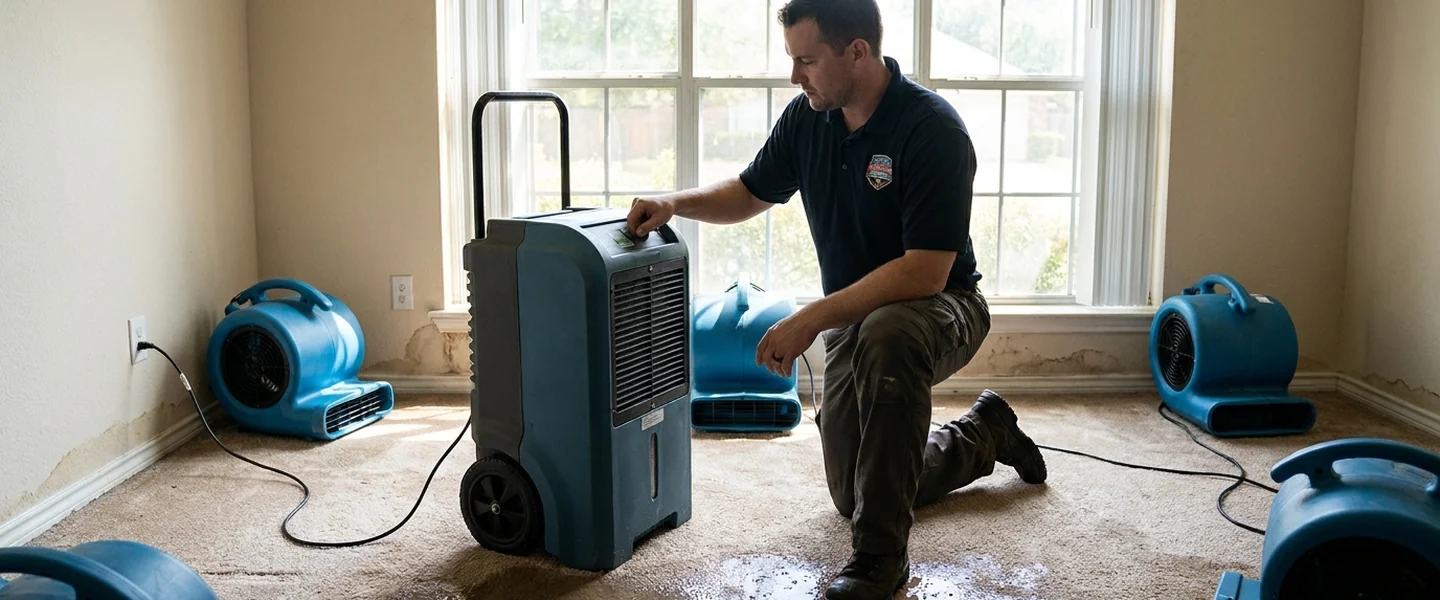
Detailed records of what drying equipment was deployed, where it was placed, when it was placed, and for how many hours it ran. These records support the equipment charges on the restoration invoice and demonstrate that equipment deployment was proportional to the loss — a common area of adjuster scrutiny on larger claims.
Daily Psychrometric Readings
Temperature, relative humidity, and specific humidity readings from inside the drying zone, recorded at every daily monitoring visit. These readings form the psychrometric log — a technical record that demonstrates drying conditions were appropriate throughout the project. Insurance adjusters trained in water damage evaluation use psychrometric logs to verify that professional-standard drying occurred.
Materials Removal Documentation
A detailed log of every material removed during selective demolition — type, quantity, and reason for removal. With photographs of each demo scope before and after. This documentation justifies the demolition scope on the estimate and prevents disputes over whether removal was necessary. Materials that cannot be dried in place per IICRC standards are documented with the technical rationale for removal.
Contents Inventory
An itemized inventory of all personal property affected, with photographs, category, condition assessment, treatment performed, and disposition (restored or total loss). This supports the contents portion of your claim and provides the structured documentation your adjuster needs to evaluate personal property losses alongside the structural claim.
Final Clearance Documentation
Moisture readings confirming all structural materials have reached drying goals, EPA antimicrobial application records, and where applicable, certified laboratory air quality test results. The clearance documentation closes the mitigation phase of the claim and supports authorization to proceed with reconstruction.
How the Process Works
From Emergency Call to Claim Resolution
Call Us First
Call Dallas Flood Pros immediately when water damage occurs. We dispatch within the hour and begin documentation from the moment we arrive. Then call your insurance company to open a claim — they will assign a claim number and adjuster. Share the claim number with us so we can reference it in all communications with your carrier.
We Coordinate with Your Adjuster
We communicate directly with your assigned adjuster — answering questions about our mitigation approach, equipment, scope, and methods. We provide our documentation package to the adjuster and follow up proactively on any outstanding questions. You are kept informed of all communications.
Adjuster Inspection
Your adjuster will typically schedule an in-person or virtual inspection of the damage. We can be present during the adjuster visit to answer technical questions and walk through our documentation. Having the restoration contractor present during adjuster inspection often leads to more accurate scope assessment and fewer supplemental requests later.
Estimate Review & Approval
Our restoration estimate is submitted to your insurance carrier for review. We use industry-standard estimating formats that adjusters are trained to work with. If there are scope questions or line item disputes, we respond with documentation and technical justification. Approved estimates authorize us to proceed with or continue the restoration work.
Direct Billing to Your Carrier
Upon approval, we bill covered services directly to your insurance carrier. Your financial responsibility is typically limited to your deductible. We track payments and communicate with the carrier's accounts payable on billing matters so you don't have to. You receive a clear accounting of what was billed, what was approved, and what your personal responsibility is.
Final Documentation Delivery
At project completion, we deliver the complete documentation package — everything from pre-mitigation assessment through final clearance. This package is yours to keep and becomes part of your claim file. We recommend retaining all water damage documentation for at least five years in case of future questions about the loss or its remediation.
Common Questions
Insurance Claims Assistance FAQs
Should I call you or my insurance company first?
Call us first. Water damage mitigation should begin immediately — waiting for your insurance company to authorize work before beginning mitigation can result in significantly greater damage and higher total claim costs. Most policies require you to mitigate further damage, meaning you have a duty to take reasonable steps to protect your property. We document everything from the moment we arrive, which supports your claim regardless of when your adjuster sees the property. Then call your insurer to open the claim while we're working.
Do I have to pay upfront and get reimbursed?
For insurance-covered losses, we handle direct billing to your carrier. You typically only pay your deductible out of pocket. We do not collect payment in advance from you for covered work — we work with your carrier on billing. Non-covered work, or losses where no insurance applies, are billed to you directly on terms we agree on upfront.
What if the insurance adjuster says less work was needed than what you performed?
We address scope disputes with documentation and technical response. Our moisture logs, thermal imaging, and material removal records provide the evidentiary basis to support the scope of our work. We are experienced at responding to adjuster questions and scope disputes and do so as part of the service — you don't need to argue technical points with your adjuster yourself. We do this on your behalf.
What types of water damage are usually covered by homeowners insurance?
This is a question for your insurance carrier — we don't interpret policies or give insurance advice. Generally speaking, and as we understand it from working with many claims, sudden and accidental water damage from events like burst pipes, appliance failures, and roof leaks is commonly covered. Flood damage from rising surface water typically requires separate flood insurance. Long-term seepage, maintenance-related leaks, and certain other scenarios may be excluded. Your policy documents and insurance agent are the right resources for coverage questions specific to your situation.
Will filing a claim raise my insurance rates?
That's a question for your insurance agent or carrier — rate impacts vary significantly by carrier, state regulations, your loss history, and the nature of the claim. We are not insurance advisors and cannot predict rate impacts. We understand this is an important consideration for many homeowners, but it's outside our area of expertise. What we can tell you is that undocumented damage that isn't properly mitigated often becomes a more expensive problem later — so the decision to file or not file should be made with full information from your agent.
Do you work with all insurance companies?
Yes. We work with all major carriers and many regional and specialty insurers. We have established working relationships with adjusters from State Farm, Allstate, USAA, Farmers, Liberty Mutual, Travelers, Nationwide, and others, as well as specialty markets. If you have a carrier we haven't worked with before, we provide the same documentation standard and the same adjuster coordination — we'll learn their process quickly.
What is a public adjuster and do I need one?
A public adjuster is a licensed professional who represents policyholders in insurance claims — they are distinct from the adjuster who works for your insurance company. We are not public adjusters and do not provide public adjusting services. Whether to hire a public adjuster is a decision some policyholders make when they believe a claim is being significantly underpaid or improperly handled. We work professionally with public adjusters when clients bring them in and provide the same complete documentation regardless. For guidance on whether a public adjuster makes sense for your situation, consult a licensed public adjuster in Texas.
How long does the claims process take?
Texas law requires insurance companies to acknowledge claims within 15 days and pay or deny accepted claims within 15 business days of receiving all requested information. In practice, straightforward water damage claims with complete documentation are often resolved within 4–8 weeks. Complex losses, large claims, or disputed scopes can take longer. Our documentation is designed to minimize back-and-forth that causes delays. We stay engaged with the adjuster throughout the process and follow up proactively.
Water Damage in Dallas? We Handle the Restoration and the Insurance Process.
Call Dallas Flood Pros first. We dispatch immediately, document everything, and work directly with your insurance carrier — so you can focus on your family while we handle the restoration.
Call (469) 771-0564 — 24/7 Emergency