Dallas, TX · Biohazard-Trained Crews · 24/7
Emergency Sewage Cleanup in Dallas, TX — 24/7 Response
Sewage backup is a Category 3 biohazard emergency. Our crews arrive in full PPE and perform CDC-compliant extraction, removal, and decontamination — protecting your family's health and your property.
Call (469) 771-0564 — 24/7 EmergencyA Serious Health Hazard
Sewage Backup Is Not a Plumbing Problem — It's a Biohazard
Sewage — whether from a backed-up toilet, a floor drain overflow, or a municipal sewer line backing into your property — is classified as Category 3 water under IICRC standards. Category 3 is the most serious water damage category, defined as grossly contaminated water that carries pathogens, bacteria, viruses, and other biological contaminants capable of causing serious illness.
Common pathogens found in sewage contamination include E. coli, Salmonella, Hepatitis A virus, Norovirus, and Cryptosporidium — organisms that can cause severe gastrointestinal illness, hepatitis, and other serious health conditions. The risk is amplified in households with young children, elderly family members, or anyone with a compromised immune system. Sewage contamination cannot be addressed with consumer disinfectants and household cleaning products — it requires professional-grade biohazard procedures.
Dallas faces elevated sewage backup risk for several specific reasons. The city's sewer infrastructure in many neighborhoods dates to the 1950s through 1980s, and aging clay and cast-iron pipes develop cracks, root intrusion, and partial collapses over time. During heavy rainfall events, aging combined sewer systems in parts of Dallas can become overwhelmed, creating surcharge conditions where sewage backs up through the path of least resistance — which is often floor drains, sinks, and toilets in the lowest levels of buildings.
Heavy rain events that produce flash flooding in Garland along Duck Creek, in Mesquite near Mesquite Creek, and in older Dallas neighborhoods near low-lying storm infrastructure frequently coincide with sewage backup events. When storm drains and sewer systems are simultaneously stressed, the risk of sewage intrusion spikes. Dallas Flood Pros responds to these compound events — flood water plus sewage backup simultaneously — with full Category 3 protocol from the moment we arrive.
Health Risk Context
Why Category 3 Contamination Requires Professional Response
Bacterial Contamination
Sewage contains extremely high concentrations of fecal bacteria including E. coli O157:H7 and other dangerous strains. Exposure through contact with contaminated surfaces, inhalation of aerosolized droplets, or indirect contact (touching a surface then touching eyes or mouth) can cause serious illness.
Viral Pathogens
Hepatitis A, Norovirus, and Rotavirus are found in sewage and are highly contagious. These viruses can persist on surfaces for extended periods and are difficult to inactivate without professional-grade disinfectants applied correctly.
Parasitic Organisms
Cryptosporidium and Giardia, parasitic organisms that cause severe gastrointestinal illness, are common in sewage and are resistant to standard disinfectants. They require specific treatment protocols for safe decontamination.
Airborne Contamination
Sewage cleanup disturbs contaminated materials and creates aerosolized particles carrying biological hazards. Without proper PPE and negative air pressure systems, cleanup activities can spread contamination throughout a structure rather than containing it.
Our Protocol
CDC-Compliant Sewage Decontamination — Step by Step
Emergency Response & Source Control
We dispatch immediately upon call receipt. Our first priority on arrival is verifying that the sewage source has been controlled — plumbing shutoffs, municipal sewer authority notification, or other means. If the source is still active, we coordinate with plumbing professionals or advise on emergency shutoffs while we prepare to begin the remediation process.
Full PPE Deployment
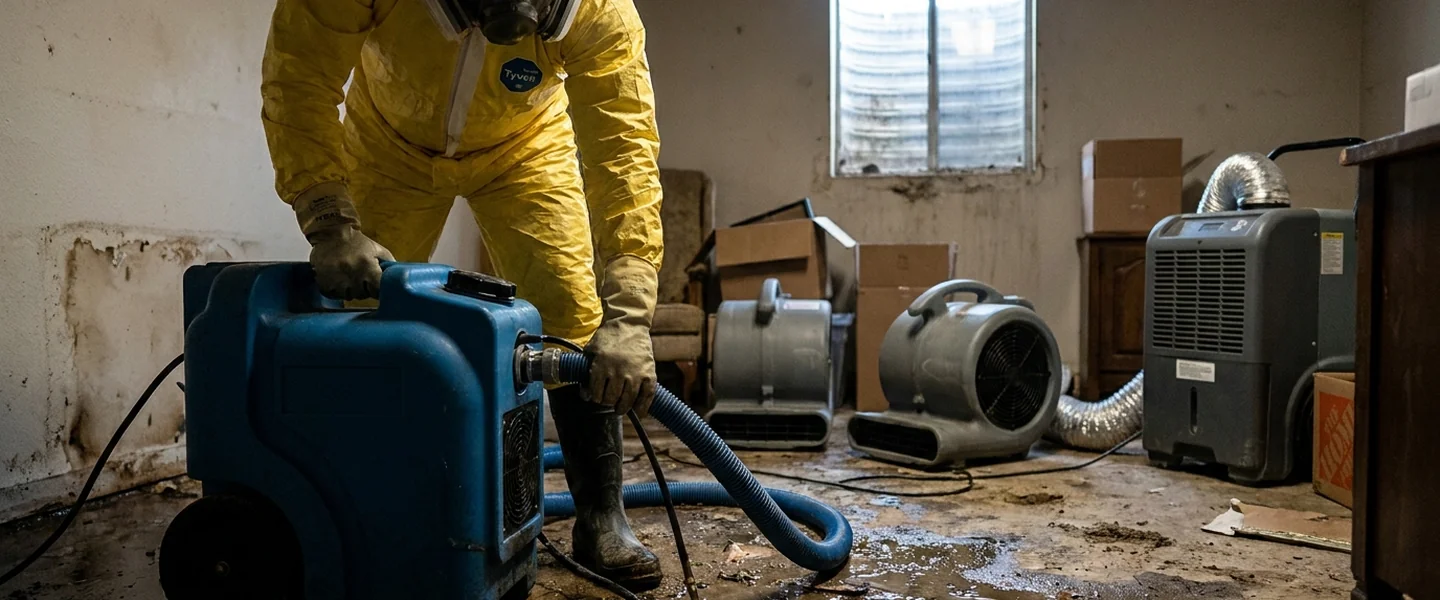
All crew members working in the contamination zone don appropriate PPE before any material contact: full-face respirators with P100 and organic vapor cartridges, Tyvek disposable coveralls, chemical-resistant gloves, and rubber boot covers. PPE is donned and doffed according to biohazard decontamination procedures to prevent cross-contamination.
Containment & Negative Air Setup
The affected area is isolated with polyethylene containment and negative air pressure machines with HEPA filtration. This prevents contaminated air and aerosolized particles from migrating to unaffected areas of the structure. HVAC systems are sealed to prevent sewage odors and pathogens from entering ductwork.
Black Water Extraction
Standing sewage is extracted using equipment dedicated to Category 3 losses and decontaminated after use. All extracted material is disposed of as biohazard waste per applicable regulations. We do not use equipment that contacts sewage interchangeably with clean-water restoration equipment.
Contaminated Material Removal
Any porous material that contacted Category 3 water — carpet, carpet pad, drywall, insulation, wood composite flooring, certain cabinetry — must be removed. Per IICRC S500 and Category 3 protocols, porous materials contaminated with sewage cannot be adequately disinfected and must be disposed of. All removed materials are double-bagged as biohazard waste.
Structural Decontamination
Non-porous surfaces — concrete, tile, metal, glass — are cleaned with HEPA vacuums and washed with EPA-registered hospital-grade disinfectants. Multi-step application (clean first, then disinfect) is required for proper decontamination — disinfectants are significantly less effective on organic-contaminated surfaces that haven't been cleaned first. All surfaces are documented as treated with product name, concentration, and contact time.
Antimicrobial Treatment & Deodorization
EPA-registered antimicrobial agents are applied to all treated structural surfaces. HEPA air scrubbers with activated carbon filtration are deployed to address airborne contamination and odors. Sewage odors in structures often persist in wall cavities and HVAC systems; we address both systematically.
Structural Drying & Final Testing
After decontamination, the area is dried using commercial equipment. Air quality testing is performed before clearance. We do not clear a sewage backup job until test results confirm that the treated area meets acceptable air quality standards. A complete project documentation package — extraction records, material removal inventory, decontamination records, and test results — is provided for your insurance claim.
Common Questions
Sewage Cleanup FAQs
Should I stay in my home after a sewage backup?
For significant sewage backups affecting living areas, we strongly recommend that household members — especially children, elderly individuals, pregnant women, and anyone with compromised immunity — temporarily relocate until decontamination is complete and air quality testing has cleared the space. Even without visible contamination, aerosolized sewage particles can affect areas adjacent to the backup zone. We'll give you specific guidance based on your situation's scope.
Why does rain cause sewage to back up through my drains?
In many Dallas neighborhoods — particularly those with older infrastructure — the municipal storm and sanitary sewer systems have cross-connections or are overwhelmed simultaneously during heavy rain. As storm water volume exceeds the system's capacity, pressure builds and sewage flows toward any available outlet — which is often floor drains, lower-level toilets, and tub drains in homes at lower elevations. This is especially common in parts of Garland, Mesquite, and older Dallas neighborhoods built in the 1950s–1970s.
Can any of my belongings be saved after sewage contact?
Non-porous hard goods — metal, glass, glazed ceramic, certain plastics — can often be decontaminated and saved. Porous items (upholstered furniture, mattresses, clothing, carpet, rugs, books, cardboard) that had direct contact with Category 3 water are generally considered unsalvageable for sanitary reasons. Electronics that contacted sewage are evaluated individually. We provide an itemized documentation of all items assessed for your insurance claim.
How much drywall has to be removed?
Per IICRC S500 Category 3 protocol, all drywall that had contact with sewage-contaminated water must be removed. This includes not just flood-line contact but also drywall that wicked moisture upward from contaminated flooring. The removal scope is determined by actual moisture readings, not an arbitrary line — we take measurements to establish the true extent of contamination and remove accordingly. Everything removed is documented for your claim.
Is sewage backup covered by homeowners insurance?
Sewage backup coverage depends heavily on your specific policy and any endorsements you have. Standard homeowners policies often exclude sewage backup damage unless a specific "sewer backup" rider has been added. Some policies cover the damage if the backup was caused by a specific covered peril (like a tree root blockage) but not if it resulted from municipal system issues. We provide complete documentation of the loss for your claim submission and work with your adjuster — but we strongly recommend reviewing your policy and calling your insurer as one of your first steps.
What's the difference between sewage backup and a flooded basement?
A flooded basement from rainwater or groundwater may be Category 1 or 2 (cleaner water) depending on its source. Sewage backup — water that entered from drain lines, toilets, or the municipal sewer system — is always Category 3 regardless of what it looks like. Even if sewage-contaminated water appears relatively clear, it is classified as Category 3 and requires Category 3 protocols. The IICRC classification is based on the source of water, not its appearance.
How quickly can you arrive for a sewage backup?
Our target dispatch time for all emergency calls — including sewage backup — is within one hour across Dallas and the DFW metro area. Sewage backup is treated as a priority emergency due to the health hazard involved. Our crews and their biohazard equipment are staged for rapid deployment 24/7, including weekends and holidays.
What should I do while waiting for your crew to arrive?
Do not attempt to clean up sewage without proper PPE. Keep family members and pets away from the affected area. If possible and safe, turn off the water supply if the backup is related to a plumbing failure. Turn off HVAC serving the affected area to prevent sewage odors from spreading through the ductwork. Document the scene with photos for insurance purposes. Do not run dishwashers, washing machines, or flush toilets until the blockage or backup source has been identified and addressed by a plumber.
Sewage Backup in Dallas? This Is an Emergency — Call Now.
Category 3 contamination puts your family's health at risk. Dallas Flood Pros dispatches biohazard-trained crews 24/7. Don't wait, don't attempt DIY cleanup — call immediately.
Call (469) 771-0564 — 24/7 Emergency